Oh, the things I would be if I weren’t a writer…in my
dreams. You know the list—singer (despite being unable to carry a tune in a
paper bag); supermodel (I’m 5’ 2”); pilot (although I’m afraid to fly)—that
kind of thing. Those dreams will remain simply dreams, when they don’t become
plot points in my books. But if I weren’t an author, and I had the time to
pursue another career, I’d be a genealogical researcher. But I’d specialize in
a very specific area—one very important to me personally.
Thing is, I’m of mixed heritage and grew up hearing stories
about some of my ancestors and how they ended up in the Caribbean. There were
the French brothers, the Scottish land manager and his gorgon of a wife, the
English gent running away from scandal. All very exciting (if ultimately more
fantasy than reality) but it was only as I got older it struck me no one spoke
about a large part of the family tree. The slaves and indentured servants, who
played a vital role in the survival of my family, were invisible and ignored.
It’s not surprising. History is written by those on the top
of the heap. In a place like Jamaica during the 17th through 19th
centuries (and, to be honest, beyond) the rich chose what and who to celebrate.
Plantations kept records but many of those have been lost, and it wasn’t until
Emancipation owners were forced to baptize the slaves and, as a corollary, give
them last names. In many cases, those are some of the first traceable records
of the slaves.
My mother was interested in genealogy and began doing
research into her family when I was a teen. After she died I became the
official keeper of the family records and chief researcher. Unfortunately it
isn’t something I’ve been able to devote a lot of time to, but last year I had
a breakthrough—and it was one of the most touching and humbling moments of my
life.

I had found a list of names among my paternal
grandfather’s possessions a number of years ago, labelled as being his
grandmother and her siblings. Using that list I was able to go back another
generation and found a woman by the name of Mary Gittoes, my great-great-great-grandmother.
It might not sound like a great find but to me it was gold, as it also
connected two arms of the family. I found a number of records of her children’s
births or baptisms and a marriage record for her and her husband, but then I
hit a dead-end, not able to find anything more. Who was she? Where had she come
from?
Fast-forward to last year, when I found a christening record
from 1811, from the time when the plantation owners were first being forced to
register their slaves, and there she was—my Mary, listed as “a child of colour”.
Then I found another record, one from 1821, from a mass baptism. The ages
didn’t seem to indicate the same person, but vernacular from that time frame is
specific and “child of colour” seems to be indicative of a child born to a
slave woman and a white or mulatto man, rather than being indicative of age.
Irrespective of whether I was looking at the records of one
woman or two, one thing was certain. Mary was a slave. She survived the
brutality of life on a plantation and the paternalistic and inhuman
post-emancipation conditions. Because of her strength, I’m here. I want to know
more, discover the truth, rather than the revisionist history we’ve been fed.
So, if I weren’t a writer, that’s what I’d be doing…and hopefully, even with my
writing career, I’ll one day have the chance to do it. That’s the part of my
heritage I’m proudest of, and I hate to think the story won’t be told.
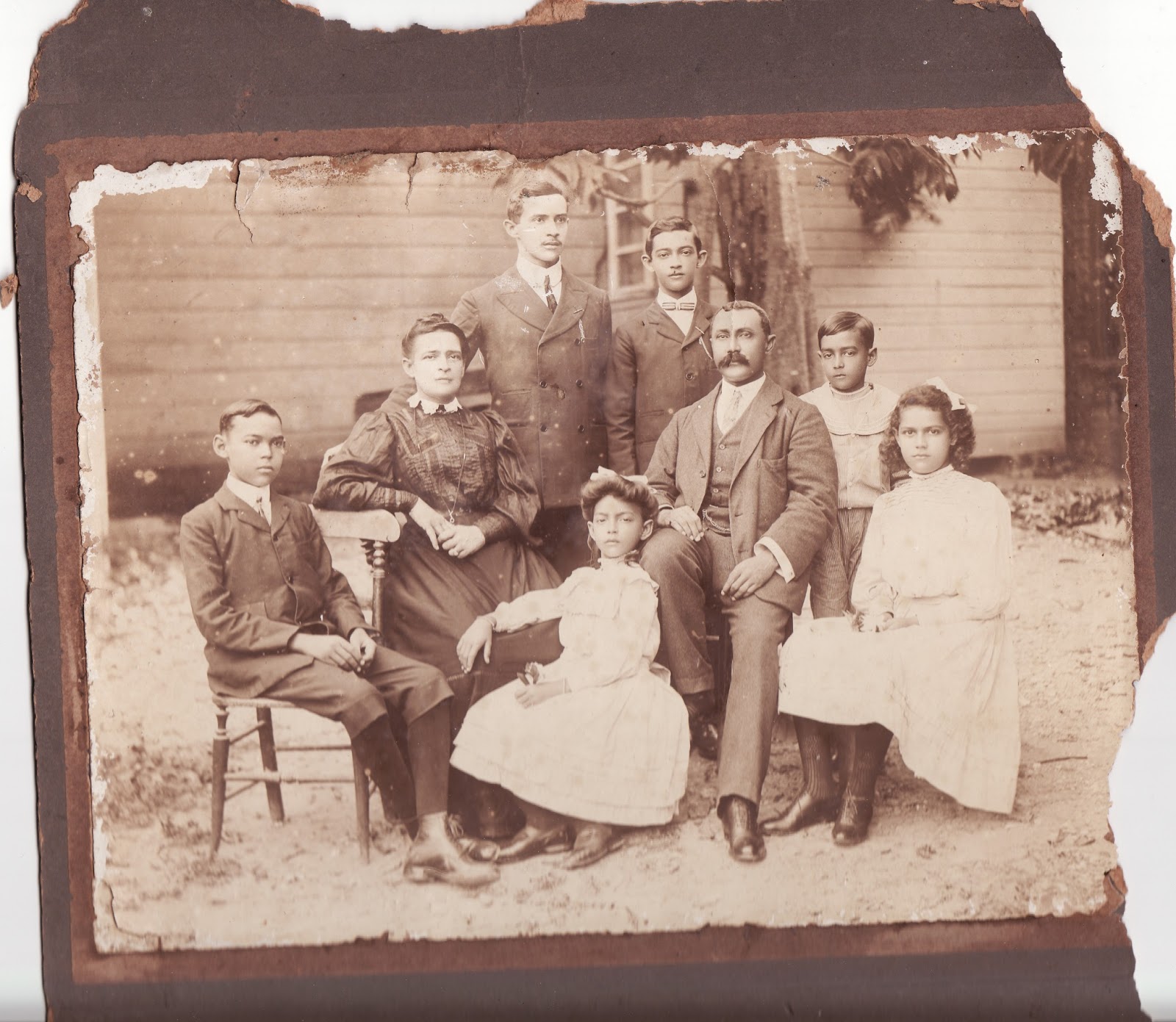 |
| My Great-grandfather and grandmother and their children. My grandfather is the one on the left. Can you imagine how they must have been sweltering in those clothes?? |
